Why Does Balance Decline After 60?
Balance declines because several distinct systems weaken at once: leg strength, ankle and hip mobility, reaction time, and the visual and inner-ear systems that tell your brain where your body is in space. Age alone is not the cause. The decline is the sum of these trainable factors, and each one responds to a different intervention.
Strength is the foundation. Standing on one leg and catching yourself mid-stumble both depend on the muscles of the hips, thighs, and calves. So does rising from a low chair. Ankle and hip mobility matter because a stiff ankle cannot make the small, constant corrections that keep you upright on uneven ground. Reaction time slows gradually, which means the recovery step that once happened automatically now arrives a half-second late. And vision and vestibular changes (new glasses, cataract surgery, inner-ear shifts) quietly change the information your brain uses to stay level.
One brief caution before training anything: sudden dizziness, new weakness in a leg, or repeated unexplained falls warrant a physician visit first to rule out medical causes. For the gradual, “I feel less steady than I used to” pattern, physical therapy is the right starting point.
The Strength Connection: Why Sarcopenia Drives Fall Risk
Sarcopenia, the age-related loss of muscle, accelerates after 50 and is the biggest modifiable driver of falls. The traditional answer is heavy resistance training, and it works. But heavy lifting is hard on aging knees, hips, and shoulders, and many older adults simply cannot tolerate the loads required.
This is where blood flow restriction training becomes one of the most useful tools we have for older adults. BFR uses a medical-grade cuff to safely reduce blood flow to a working limb, which allows light weights, often 20 to 30 percent of what traditional strength work requires, to produce strength and muscle gains typically seen only with heavy lifting. In our experience, patients in their 60s, 70s, and 80s who could never tolerate a heavy squat can build meaningful leg strength this way. Our personalized blood flow restriction program calibrates the cuff pressure to each individual, which is a safety step we do not skip.
What Does a Balance Evaluation Include?
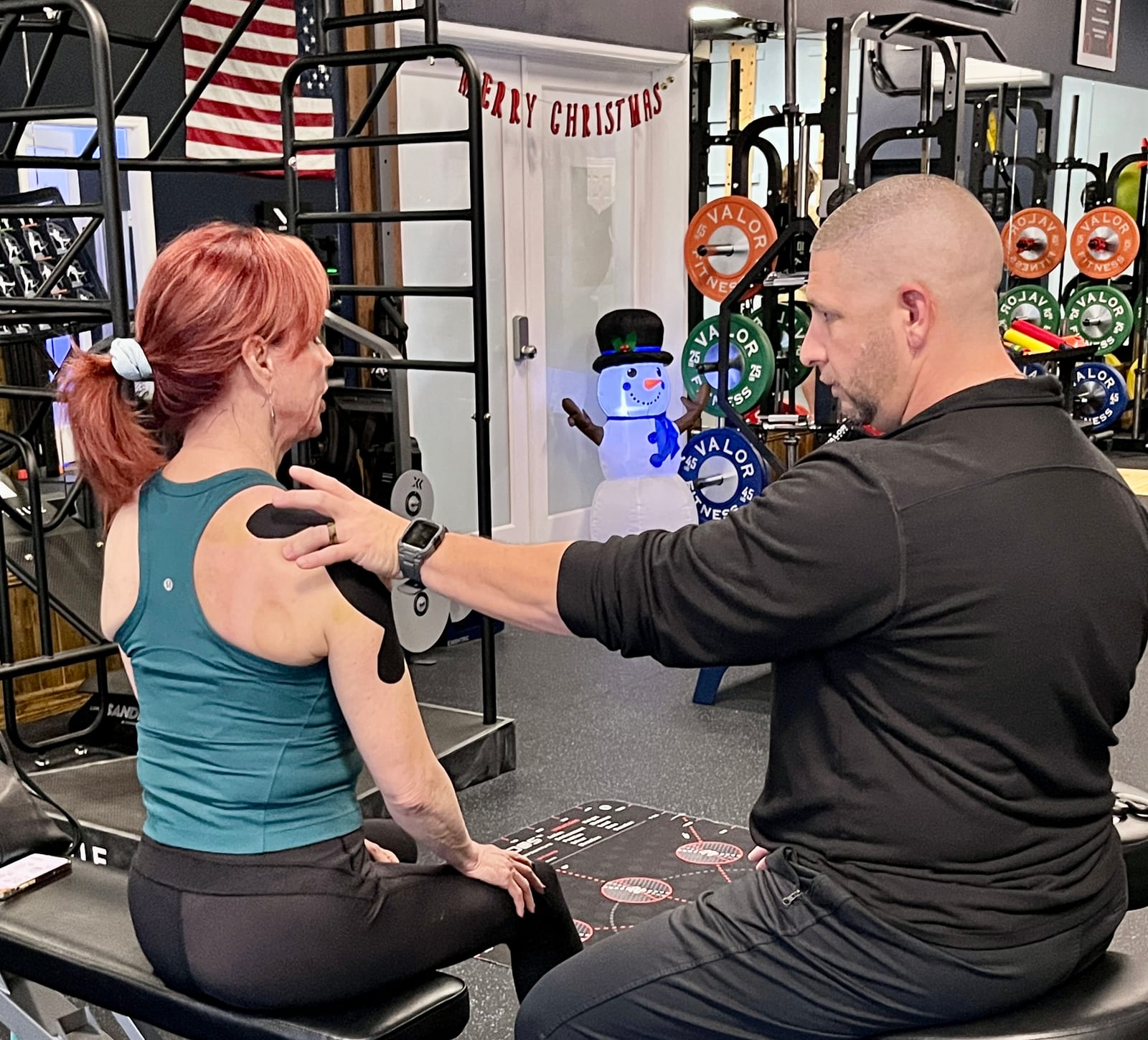
A balance evaluation is a structured, one-hour assessment that identifies exactly which system is failing you. “Work on your balance” is useless advice until you know what to work on. At our clinic, the evaluation typically includes:
- Strength testing of the hips, thighs, calves, and core, including sit-to-stand performance
- Single-leg stance time, measured on each side with eyes open and eyes closed
- Gait analysis: walking speed, step width, and how you handle turns and head movements
- Reactive stepping: how quickly and accurately you recover when your balance is genuinely challenged in a controlled setting
Every session at our clinic is a full hour, one-on-one with a Doctor of Physical Therapy. That format matters for balance work, where supervision quality directly affects both safety and results. We cover why in our comparison of one-on-one versus group physical therapy.
What Does Balance Training Actually Look Like?
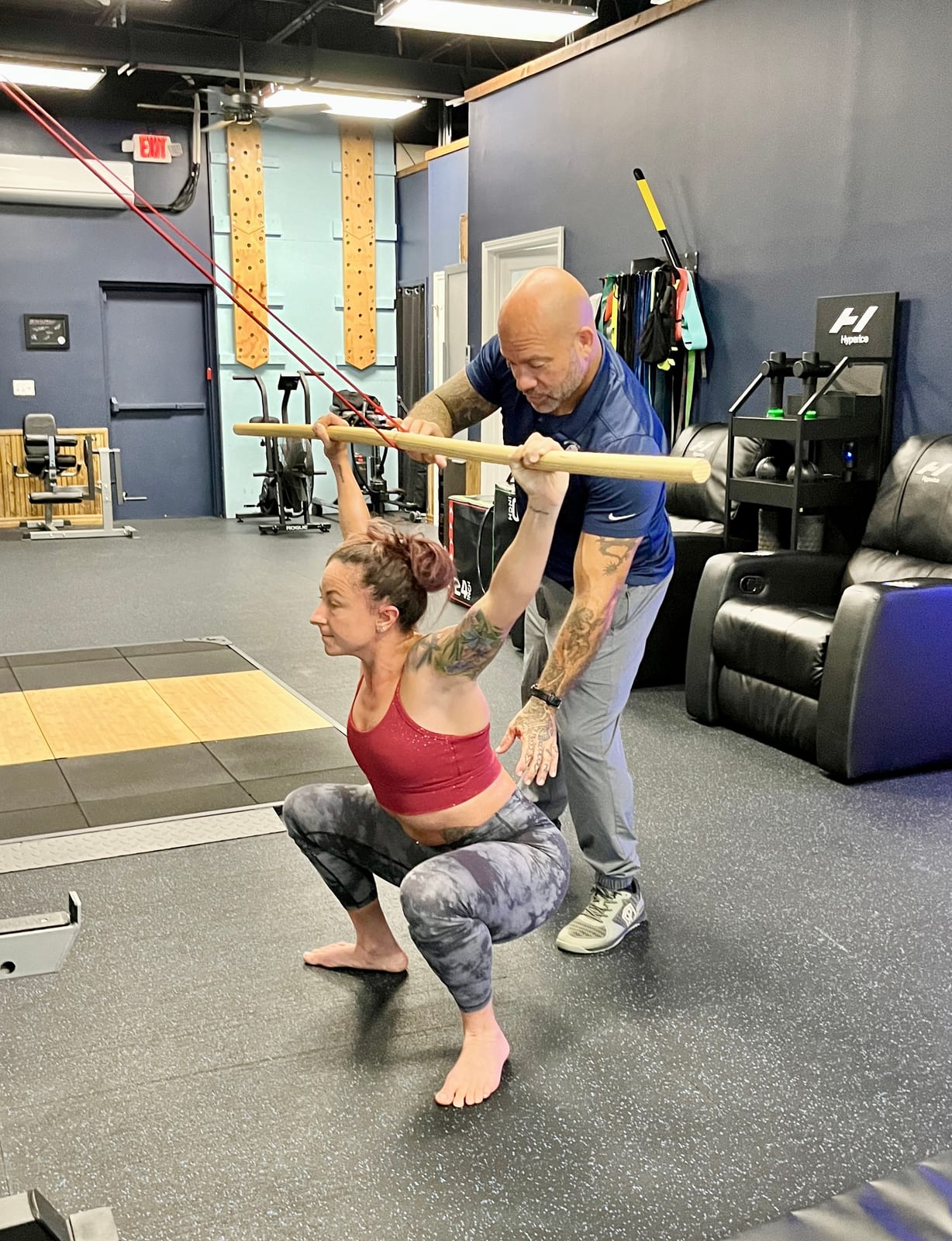
Effective balance training is progressive strength work, balance-specific drills, and reactive training, in that order of priority. A typical plan includes:
Progressive strength training. Squats to a box, step-ups, calf raises, and hip work, loaded appropriately, with BFR when joints will not tolerate heavier weight.
Balance drills that advance. Standing with a narrowed base, then single-leg, then unstable surfaces, then the same drills with head turns and eye closure. The drill should always feel slightly challenging; if it is easy, it is not training anything.
Reactive training. Real falls happen when something unexpected occurs, so we train the unexpected. We use BlazePods, light-based reaction pods, to build the fast, accurate stepping responses that catch a stumble before it becomes a fall.
A home program. Most of the repetitions that change your balance happen between visits. We build a short daily routine and progress it as you improve.
Fall-Risk Factors and What We Do About Each
| Risk factor | How we address it |
|---|---|
| Leg strength loss | Progressive resistance training; blood flow restriction when heavy loads are not joint-friendly |
| Slow reaction time | Reactive stepping drills and BlazePods light-reaction training |
| Ankle stiffness | Manual therapy and joint mobilization, plus daily mobility work in the home program |
| Fear of falling | Graded, supervised challenges that rebuild confidence one proven success at a time |
| Home hazards | A practical walkthrough checklist covering lighting, rugs, bathroom grab points, and footwear |
A Word to Adult Children Helping a Parent
If you are reading this on behalf of a parent, a balance evaluation is one of the most practical gifts of independence you can give. Most older adults do not mention balance concerns until after a fall, often because they fear the conversation ends with someone taking their car keys or their independence. An evaluation reframes it: this is training, not surveillance, and the goal is more independence for your parent. Many families in our practice book the initial evaluation as a gift, and we walk the parent through everything at their pace. You can review what we treat and our payment options ahead of time.
Do You Need a Referral to Start?
No. Florida is a direct access state, which means you can begin physical therapy without a physician referral. One detail worth knowing: if care for a new condition runs past 30 days, Florida law requires a physician or other practitioner of record to review and sign the plan of care. This is routine coordination we handle for our patients, and it rarely affects scheduling. The full details are in our Florida direct access guide.
Frequently Asked Questions
Is it too late to improve balance at 75? No. In our experience, most patients in their 70s and 80s make measurable gains in strength and single-leg stance within weeks of starting a structured program. The nervous system remains trainable at any age; the timeline is simply a bit longer than it would be at 50.
How long does balance training take? Most patients notice improved steadiness within four to six weeks, with larger strength changes building over two to three months. Timelines vary with your starting point. We cover the general pattern in how long physical therapy takes.
Does Medicare cover balance training at your clinic? We are a self-pay practice and do not take insurance. Many patients use HSA or FSA funds, since physical therapy treatment of an injury or condition is a qualified medical expense, and we provide superbills for those pursuing reimbursement. Details are in our HSA, FSA, and Reimbursify guide.
What home changes reduce fall risk? Remove loose rugs, add night lighting between bedroom and bathroom, install grab bars near the tub and toilet, keep walkways clear of cords, and wear supportive shoes indoors rather than socks. We review a full checklist during the evaluation.
Can I do balance training if I already use a cane? Yes. Using a cane means training matters more, not less. We work with the cane at first, build the strength and reactions underneath, and in many cases patients progress to using it only in specific situations, or set it aside with their physician’s blessing.
This article is general information from the team at Improved Motions Physical Therapy, not medical advice for any specific condition. For evaluation of your situation, see a licensed provider.
What Makes Improved Motions Different
- A full hour, one-on-one, every visit. You work with a Doctor of Physical Therapy the whole time. No aides running your session and no other patients sharing your hour.
- Self-pay, so your recovery sets the plan. No insurance visit caps or authorizations. HSA and FSA cards are accepted, and you get a superbill for out-of-network reimbursement. See payment options.
- No referral needed. Florida is a direct access state, so you can book an evaluation directly.
- A Recovery Room under the same roof. Cryotherapy, hyperbaric oxygen, red light therapy, Normatec compression and PEMF, guided by the same team treating you. See the Recovery Room.
- Advanced, hands-on training. Dry needling, blood flow restriction training, manual therapy and functional movement analysis, led by founder Dr. Michael Mann, PT, DPT.
- 5-star rated by our patients on Google, right here in Stuart and serving the Treasure Coast.
Get Started at Improved Motions
Florida is a direct access state, so you can start physical therapy without a physician referral. Call (772) 214-4402 or book online to schedule your initial evaluation.
We serve patients in Stuart, Palm City, Jensen Beach, Port St. Lucie, Hobe Sound, Jupiter, Tequesta, Indiantown, and throughout the Treasure Coast.